 Skip to content






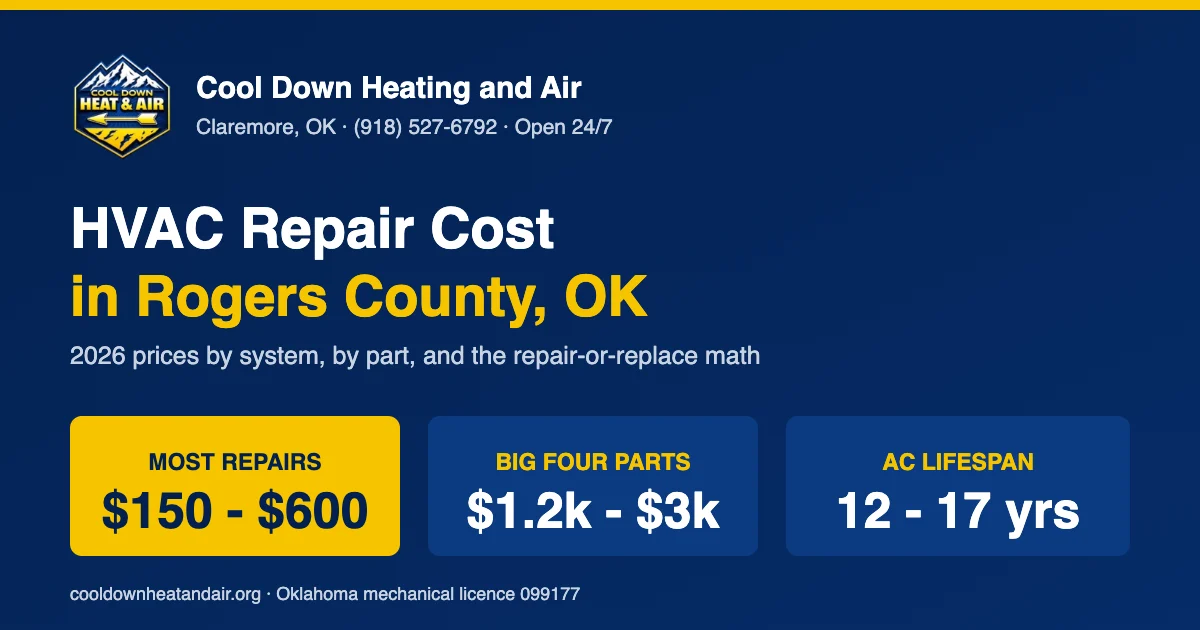
HVAC repair in Rogers County runs $150 to $600 for most jobs in 2026. Simple electrical and sensor faults sit near the bottom. Compressors, coils and heat exchangers run into the thousands. Booking HVAC services in Claremore before peak season is the single biggest lever on what you end up paying.
Written by Ricky Roberts, Owner, Oklahoma mechanical licence 099177, licensed 7 years
In this article: the real 2026 range, cost by system type and by part, why Oklahoma systems cost more to keep running, the repair-or-replace math, and how to cut your annual HVAC spend.
Key Takeaways
- Most repairs. $150 to $600, parts and labor included, on a residential split system.
- The big four. Compressor, evaporator coil, heat exchanger and full duct replacement are the repairs that cross $1,500.
- Two seasons of load. Rogers County systems work hard in July and again in January, so parts wear faster than in a single-season climate.
- Timing beats negotiating. The same repair booked in April costs less than the same repair booked in a July heat wave.
- Budget, do not react. Plan on one service call and one tune-up a year. That is a known number instead of a surprise.
How Much Does HVAC Repair Cost in Rogers County?
HVAC repair in Rogers County costs $150 to $600 for most jobs in 2026. Capacitors, thermostats, flame sensors and drain line clogs fall at the low end. Blower motors, control boards and refrigerant leaks run $400 to $1,500. Compressors, coils and heat exchangers reach $1,200 to $3,000 and usually change the repair-or-replace conversation.
That range covers a standard residential gas furnace paired with a central air conditioner. Package units, mini-splits and heat pumps carry their own numbers, listed below.
What a typical year actually costs
Most Claremore homeowners with a system under ten years old spend on two things a year: one seasonal tune-up and, some years, one repair visit. That is a planned number, not a crisis. The homeowners who get hurt are the ones running a 15 year old system with no maintenance, because their bill arrives all at once, in the worst week of the year, at emergency rates.
HVAC Repair Cost by System Type
Not every system costs the same to fix. Parts availability, refrigerant type and how much of the equipment sits outdoors all move the number.
| System | Typical 2026 repair | What usually fails first |
|---|---|---|
| Central air conditioner | $200 to $1,200 | Capacitor, contactor, drain line, fan motor |
| Gas furnace | $150 to $900 | Flame sensor, ignitor, limit switch, inducer |
| Heat pump | $250 to $1,500 | Defrost board, reversing valve, fan motor |
| Ductless mini-split | $300 to $900 | Indoor board, line set leak, blower wheel |
| Package unit | $350 to $1,400 | Weather exposure, electrical, blower |
| Ductwork | $250 to $1,800 | Disconnected runs, crushed flex, leaking seams |
HVAC Repair Cost by Part in 2026
Prices below are parts and labor together, for a residential system in the Claremore and Tulsa market. Your number depends on brand, age and whether the part is still under manufacturer warranty.
| Repair | Typical 2026 cost | Notes |
|---|---|---|
| Drain line clear | $100 to $250 | Common in humid Oklahoma summers |
| Capacitor | $150 to $350 | Most common summer no-cool call |
| Contactor | $150 to $350 | Often paired with the capacitor |
| Flame sensor or ignitor | $100 to $450 | Most common winter no-heat call |
| Thermostat | $150 to $400 | More if a smart model is fitted |
| Condenser fan motor | $300 to $700 | Runs hot all summer, wears out |
| Blower motor | $500 to $1,400 | Variable speed motors cost more |
| Control board | $450 to $1,000 | Discontinued boards cost more |
| Refrigerant leak repair | $400 to $1,600 | Depends where the leak is |
| Evaporator coil | $900 to $2,400 | Replacement, not repair, in most cases |
| Compressor | $1,200 to $3,000 | Usually means pricing a new system |
| Heat exchanger | $1,500 to $2,500 | Safety issue, and usually terminal |
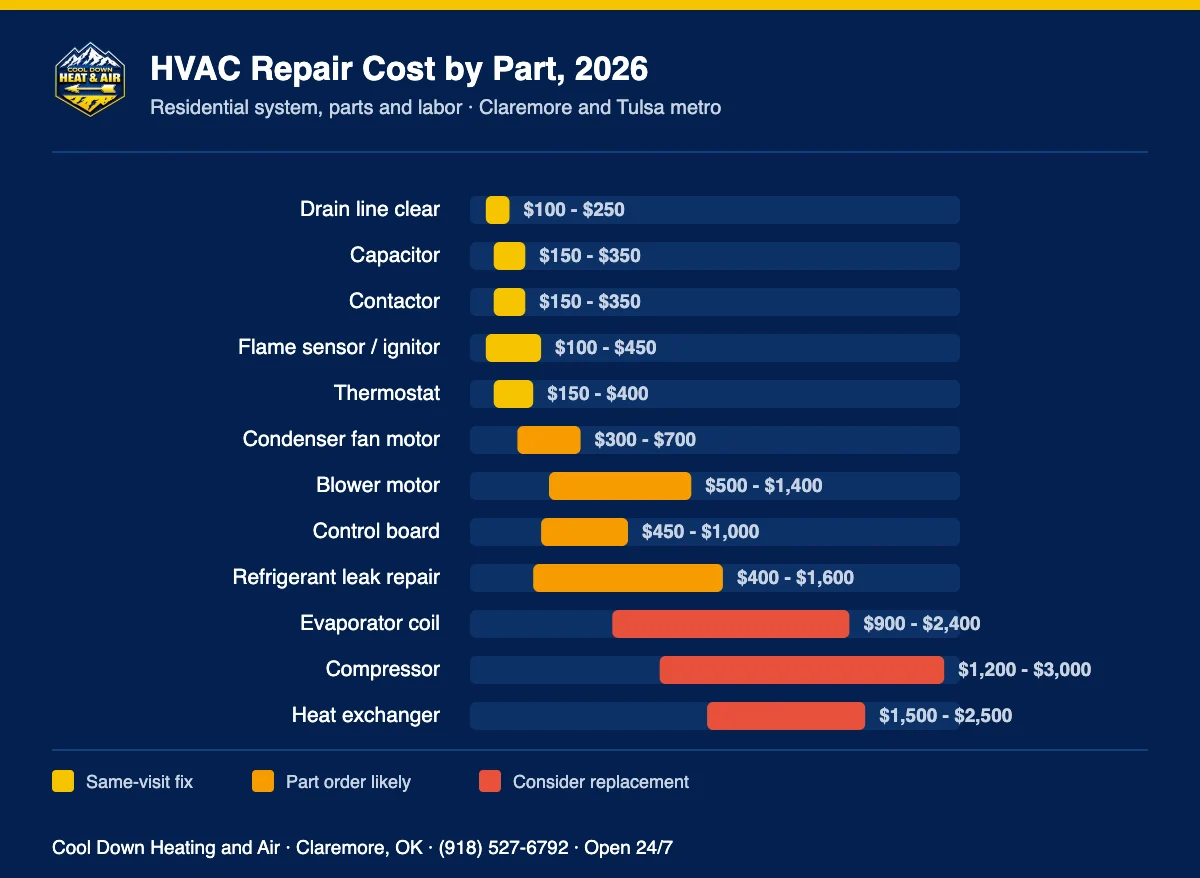
Anything above the blower motor line is a same-visit fix on a stocked truck. Anything below it means a part order, a second visit, and a bill that starts to compete with new equipment.
Why Oklahoma Systems Cost More to Keep Running
Two hard seasons, not one
A system here does not get an easy half of the year. Tulsa averages 10.8 days a year at 100 degrees or hotter under the 1991 to 2020 normals, according to Tulsa 100 degree days records from the National Weather Service. Then the same house piles up hundreds of Tulsa heating degree days in December and January. Compressors and blower motors accumulate run hours in both directions.
Cheap power encourages expensive habits
Oklahoma’s average retail electricity price was 9.09 cents per kilowatt hour in 2024, ranking 48th in the country, per the Oklahoma electricity price data published by the U.S. Energy Information Administration. Cheap power is good news for the monthly bill and bad news for the equipment, because a struggling system can run almost continuously without the homeowner noticing on the statement. The failure shows up before the bill does.
Peak season pricing is real
Every contractor in Green Country is busiest in the same two windows. In July and in the first hard freeze, parts run short, schedules fill, and after-hours rates apply. The identical capacitor swap can cost 30 to 50 percent more in a heat wave than it does in April. If your system is limping, that is the argument for calling early rather than waiting to see if it holds.
Signs You Are About to Get an HVAC Repair Bill
Systems rarely fail without warning. These are the tells:
- Longer run times. The unit runs and runs but the house never quite reaches the set point.
- Short cycling. It starts, runs two or three minutes, shuts off, repeats.
- New noises. A hum, a grind, a rattle or a click that was not there last season.
- Weak airflow. Registers that used to push now barely move air.
- Water where it should not be. Standing water near the indoor unit means the drain is backing up.
- A bill that climbed with no rate change. The system is working harder for the same result.
- Breaker trips. Never reset a breaker more than once. That is an electrical fault asking for attention.
Catching any two of these early is usually the difference between a $250 fix and a $1,200 one. A seasonal check under one of the HVAC maintenance plans exists for exactly this reason.
Repair or Replace: The Numbers to Run
Do not decide this from a driveway conversation. Work through it in order.
- Find the age. The data plate on the outdoor unit and on the furnace both carry a manufacture date. A central AC lasts 12 to 17 years in Oklahoma heat, a gas furnace 15 to 20.
- Get the repair in writing. Part named, part price, labor separated.
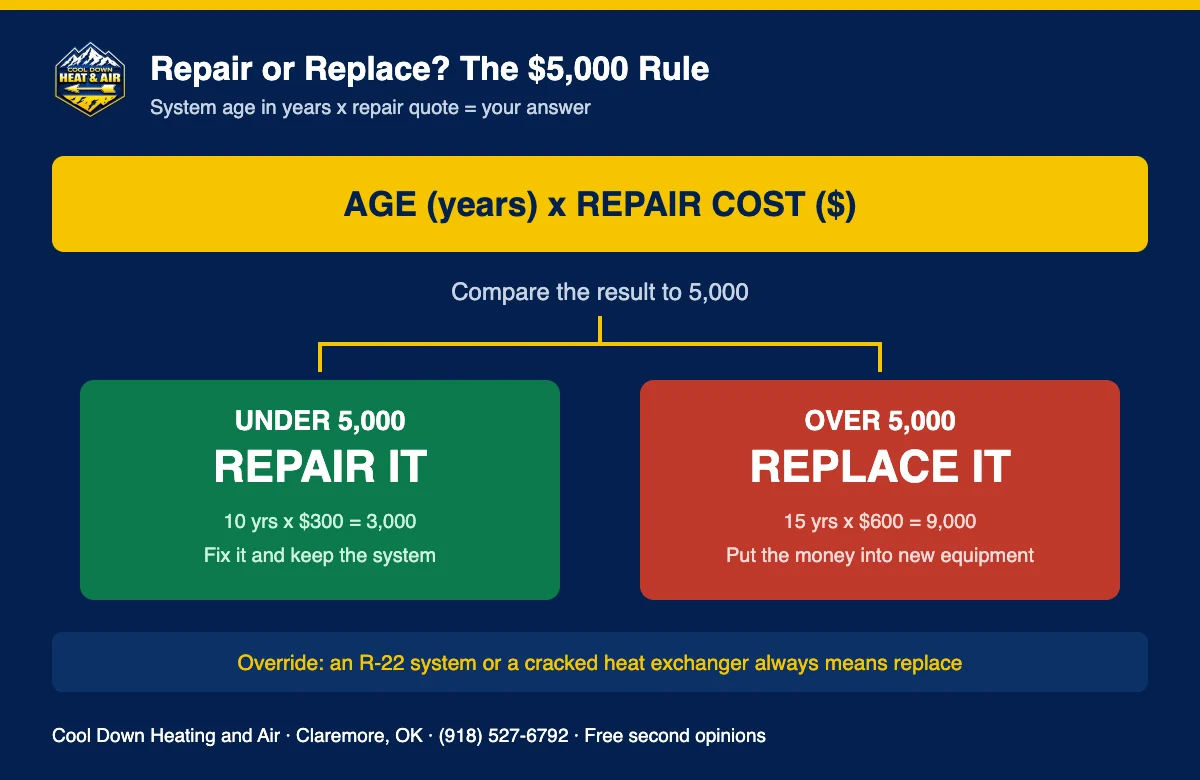
- Multiply age by repair cost. Over roughly $5,000 and replacement is usually the better spend. A 14 year old AC with a $600 repair scores 8,400, which says replace.
- Count the last two years. Two or more repairs on the same system is a pattern.
- Check the refrigerant. A system still on R-22 has no future. Any refrigerant repair on one is money spent on borrowed time.
- Price the alternative. Get a real replacement quote before you approve a large repair, so you are comparing two numbers.
| Signal | Usually repair | Usually replace |
|---|---|---|
| System age | Under 10 years | Over 14 years |
| Repair quote | Under $600 | Over $1,500 |
| Repairs in 2 years | None or one | Two or more |
| Refrigerant | R-410A or newer | R-22 |
| Part warranty | Still active | Expired |
| Comfort | Even room to room | Hot and cold rooms |
Not sure which column you are in? Call Cool Down Heating and Air at (918) 527-6792 and ask for a diagnosis with both numbers on paper. Free second opinions on repair and replacement quotes are standard here, so a number you already have can be checked before you sign it.
How to Cut Your HVAC Repair Spend
- Change the filter on a schedule. Every 60 to 90 days, more often with pets. A restricted filter is behind a large share of blower and limit switch calls.
- Book maintenance in the shoulder months. April and October. Techs are available, rates are normal, and problems get found before the season starts.
- Keep two feet clear around the outdoor unit. Cottonwood, grass clippings and shrubs choke the condenser and drive up head pressure.
- Verify the licence before you book. Oklahoma mechanical contractors are licensed by the state Construction Industries Board, and anyone can check a name free with the Oklahoma license verification tool.
- Register new equipment. Manufacturer warranties often require registration within 60 to 90 days. Skipping it can cut a ten year parts warranty to five.
- Get a second opinion above $1,000. Especially on compressors, coils and heat exchangers.
- Fix small things immediately. A $200 capacitor left alone can take the compressor with it.
If the fault is on the cooling side specifically, the pricing detail sits on the AC repair in Claremore page. For heating, the full breakdown is in the furnace repair cost guide.
HVAC Repair Cost Questions Rogers County Homeowners Ask
What is the $5,000 rule for HVAC?
Multiply the age of the system in years by the repair estimate. If the result is over $5,000, replacement is usually the smarter spend. A 10 year old unit with a $300 repair scores 3,000, so repair it. A 15 year old unit with a $600 repair scores 9,000, so replace it.
Is it worth fixing a 20 year old AC unit?
Rarely. At 20 years the compressor is near the end, parts may be discontinued, and the unit likely runs R-22 refrigerant that is no longer produced. Small electrical fixes under $300 can buy a season. Anything larger is money spent on a system you will replace within two years anyway.
How much is a typical HVAC service call?
Expect $89 to $200 for a diagnostic visit in the Claremore and Tulsa area, with after-hours and holiday calls higher. Ask two questions before booking: is the fee credited toward the repair if you approve the work, and does the quote afterward include both parts and labor.
How much is a new AC unit for a 2,000 square foot house?
A complete central AC replacement for a 2,000 square foot Oklahoma home typically runs $4,200 to $12,000 installed, depending on tonnage, efficiency tier, brand and whether the ductwork needs work. A straightforward like-for-like swap sits near the lower half of that range.
How many years should an AC unit last?
Twelve to 17 years in Oklahoma. The heat here shortens the top end compared with milder states. Annual maintenance, a clear condenser and correct refrigerant charge are what push a unit toward the upper figure instead of the lower one.
What is the cheapest way to replace my HVAC system?
Replace in the shoulder season, take a standard efficiency tier rather than premium, keep the existing ductwork if it tests sound, and use manufacturer or utility promotions where they apply. Financing spreads the cost but does not lower it, so compare the total, not the monthly payment.
Get a Straight HVAC Repair Price Before You Approve Anything
Call Cool Down Heating and Air at (918) 527-6792 and ask for a diagnostic with the part named and the labor priced separately, in writing. You will talk to a licensed Oklahoma mechanical contractor, not a call center. Free second opinions on any repair or replacement quote you already have. Service runs 24/7 across Claremore, Tulsa, Owasso, Catoosa, Verdigris, Collinsville and Broken Arrow. You can also request a written estimate online.
Cool Down Heating and Air
24606 US RTE 66 #4
Claremore, OK 74019
Phone: (918) 527-6792
Hours: Open 24 hours, 7 days a week
Website: https://www.cooldownheatandair.org/
Service area: Claremore, Tulsa, Owasso, Catoosa, Verdigris, Collinsville, Broken Arrow and nearby Northeast Oklahoma communities
About the Author
Ricky Roberts is the owner of Cool Down Heating and Air in Claremore, Oklahoma, and holds Oklahoma mechanical licence 099177. He has been licensed for seven years and has run the company since 2019, serving homeowners and light commercial customers across Rogers County and the Tulsa metro. Learn more on the Cool Down about page.
